VISUAL MEDITATION - "The Triumph of Life: Celebrating Life in the Fields of Hardship"

A Reflection for Hispanic Heritage Month
By Paul G. Chandler - September 15, 2026:

“All my art is about life.”
Adolfo Pérez Esquivel, artist, activist, and Nobel Peace Prize laureate
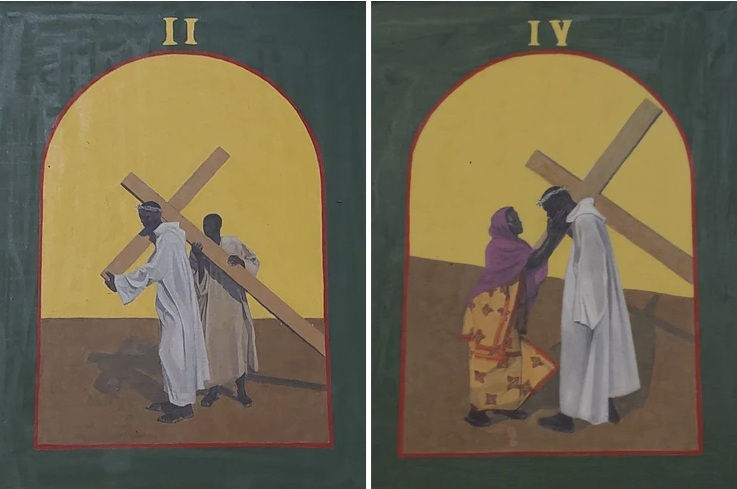
I was completely captivated by this painting the first time I encountered it. Standing in front of it mesmerized, I found myself contemplating its poignant layers. The work was painted by one of my heroes, the renowned Argentinian artist and humanitarian Adolfo Pérez Esquivel. He is a remarkable man - a human rights activist, and the winner of the 1980 Nobel Prize for Peace. This painting is the 15th and final piece in his iconic Stations of the Cross series which he created to mark 500 years since the colonization of the Americas. In this series of paintings, he contextualizes the traditional “Stations of the Cross” into the contemporary world of Latin America, thereby portraying the struggles of its Indigenous and oppressed peoples.
It features Jesus, with new life, leading a vibrant crowd of the oppressed, landless, and marginalized, as well as martyrs. The upper right shows the ships of the Spanish Conquistadors. Just in front of the ships, he portrays the violent extermination of Indigenous peoples. The upper back left draws attention to modern industrial globalization and the suffering it has inflicted on so many of his fellow Latin Americans.
While religious devotion traditionally features only 14 stations, Pérez Esquivel added a 15th, naming it Triumph of Life. This is why he portrays them all walking below a symbolic sun, representing the collective victory of life, and hope over any hardship. Commenting on his art, Pérez Esquivel says, "For me there is no difference between art and life, it’s the same thing. It’s the form of saying something which you carry inside and want to transmit.” Triumph of Life profoundly embodies my own experience of Latin America.

As the US begins the commemoration of Hispanic Heritage Month, I am reminded of how much we have to learn from our sisters and brothers in Latin America. Over the years, I have spent considerable time with Latin American contemporary artists, especially Cuban, Mexican, and Guatemalan, and I have found that much of their work embodies a profound dimension of human existence needed in our contemporary context.
Once when in Guatemala, I spent some time in a little town by the name of Panajachel on the edge of Lake Atitlán. It is one of the most beautiful and tranquil places I have ever experienced. This town sits on the large fifty-square-mile lake with three towering volcanoes rising along its shores. Between the volcanoes stand massive granite cliffs that beautifully reflect shades of gray, blue and purple, depending on the sun’s position.
One morning just after dawn, with the sun still orange on the water, I arranged for a villager to take me out toward the middle of the lake in his motorboat. When we were a good distance from the shore, he cut the engine. The water was absolutely still. We floated in silence, except for occasional splashes of leaping fish. The sights, sounds and smells were mesmerizing. I experienced the deepest sense of calm and peace. And it was there, sitting on a boat in the middle of the lake, that the realization struck me: I was doing something I had not done for some time – celebrating the gift of life.
This so perfectly matched the Latin American culture surrounding me. While Latin Americans, most of whom are Hispanic, vary greatly depending on country, ethnicity, race, political persuasion, and spiritual expression, there are two characteristics they often share; a natural orientation to celebrating life, and an understanding of time that allows them to savor that gift. This is an explosive combination and a contagious one, holding a promise of much-needed spiritual vitality for our world.
Over 90% of Latin Americans identify as Christian, making it one of the most Christian regions in the world. However, there is no limit to the variety of their spiritual expressions that reflect their numerous cultures. In spite of all the diversity, their faith traditions are usually celebrative, expressing the transcendent dimension of life in festive ways, and delighting in life as the sacred gift that it is.
Paradoxically, while Latin Americans are known for their celebrative nature of life, they have also experienced profound suffering, ever since Christianity was first brought to their continent by the Spanish and Portuguese conquerors at the turn of the 15th century. Their struggles continue today in other ways, as they live under numerous limitations, instability, and at times violence. Drug cartels, immigration, guerrilla activity, and corrupt authoritarian governments, have subjugated many to a submerged class, living at the level of poverty. Yet in the midst of their struggles, I have found that they possess the inspiring disposition to celebrate the gift of life in all its manifestations – joy and sorrow, pain and wholeness.

One cannot help but observe the celebratory nature of Latin Americans. I have rarely been able to end a day in Latin America, no matter the hour, without hearing the sounds of festive music playing in the background. There always seems to be a party going on late into the night somewhere. Music making envelops them – with the marimba, harps, flutes, panpipes and drums, and the popular rhythms of calypso, salsa and samba. Hence, dance is inherent to their musical nature – just think of the cha-cha, mambo, tango and conga.
Their art, both contemporary and historic, confirms this inherent perspective on life. Ancient pre-Columbian sculptures depict humans not as freestanding but rather restricted by the mediums of rock or wood into which they are carved. However, their cramped poses often stand in sharp contrast to the lighthearted expressions on their faces, as they communicate a joyful spirit within a restricted situation. Around 500 C.E., the Mochica potters in Peru experimented with different types of facial expressions until they were able to produce natural, spontaneous and infectious expressions – such as laughing individuals with wide, happy grins and eyes almost closed in laughter.

Today’s Latin American artistic creations – whether painting, fabric designs, or pottery – are known for their spectacularly bright colors. Contemporary Latin American art is expressive and vibrant. Whether an artist is a primitivist of Indigenous heritage or a contemporary Hispanic painter, he or she very often speaks artistically through the spiritual language of color.
A Latin American artist once said to me, “Spirituality flows in our veins and overflows from our souls.” Reflecting on his imprisonment, when he was tortured under the military dictatorship in Argentina during the 1970s and 80s, the artist Adolfo Pérez Esquivel says, "I passed through torture and the death flights but I never entered into existential anguish. It was my spirituality which saves me and saved me from seeing the horror and the death.” This spiritual worldview infuses Latin Americans with the natural gift of celebrating life, and is seen throughout their faith traditions. They have even reminded me that the Divine Artist is celebrative in nature. They resonate deeply with the way in which “life” and “joy” were embodied in the life and teachings of Jesus; “I have come that they may have life to the full” and “I have told you this… that your joy may be complete.” Latin Americans remind us that Jesus enjoyed fiestas, and that his first public contribution was the gift of delectable wine at a wedding, providing an important glimpse into his values and personality. One could describe the Latin American worldview as concerned with the existential now. Their spirituality has led them to understand the difference between existing and truly living. In understanding life as sacred, one can see each and every moment as an opportunity to embrace the gift of life.
One Saturday afternoon found me visiting art galleries in the artsy Zona Rosa district of Mexico City. As I stood admiring a sculpture, I was approached by the artist herself, who just happened to be present that day. When I expressed how much I liked her colorful sculpture, she ever so naturally described to me a recent renewal experience in her life. She had such a fresh and contagious view of life, which she clearly saw as to be lived as a celebration. I lingered in that gallery in front of her work captivated by her way of being.
Cuba is without a doubt the most celebrative country I have ever visited. Although Cubans have had their fair share of challenges over the years, I have yet to experience any culture and people with greater joy. Once during a lively church service in Cuba, the woman next to me, enthusiastically commented, “You know, my Jesus always dances.”
Latin Americans remind me of how the writer of the ancient book of wisdom on the art of living, Ecclesiastes, makes the important observation that in the balance of life, laughter and dance go hand in hand with crying and pain. The wise sage of Ecclesiastes teaches that during life’s various periods, in both ease and hardship, in want or plenty, the gift of life is always on offer from the Divine Artist. This echoes the way in which so many Latin Americans approach their reality, believing that the Divine Artist’s intention for us, regardless of the days of darkness experienced, is to embrace the gift of life. They have found a way to allow life to triumph regardless of the circumstances – joy and sorrow, pain and healing, success and failure, struggle and leisure, strength and weakness. Their view of life reflects the words of one of my mentors, Kahlil Gibran, when he wrote, “The deeper that sorrow carves into your being, the more joy you can contain.” Hence, one feels that they are continually looking for reasons to celebrate, with all of life offering the possibility of fiesta.

The Old Man and the Sea comes to mind, which earned Ernest Hemingway the Pulitzer Prize and led to a Nobel Prize for Literature. His novella mirrors the worldview that many Hispanics share. On one level it is a tragic adventure story of an old Cuban fisherman, Santiago, and a young Cuban boy, Manolin, and their fishing exploits. On another level it is a spiritual parable, filled with symbols and metaphors. Santiago is seen as unvanquished, with a noble acceptance of the limitations forced upon him. At its deepest level the book is a parable of humanity’s unconquerable spirit, capable of snatching victory from circumstances of disaster and apparent defeat.
I remember visiting a village on the border of the jungles of Petén in northern Guatemala. During an evening meal with an Indigenous family, I was told about an elderly Mayan man living in the village who had recently experienced great suffering and was believed to be dying. He was seen as the village’s spiritual leader and highly respected. People were deeply concerned at the prospect of losing him. The family took me to visit him, and I found him sitting up on his floor mattress, smiling widely. He was extremely frail, and his large smile did not seem to fit his gaunt, wrinkled and gap-toothed face.
I recall us laughing more than talking, but in our relatively short conversation I was able to get a glimpse of what he had been through. His wife of thirty-two years had died just four months earlier. He had had three children. His first son died at the age of ten when hit by a truck on the street that ran through the village. His next child, a daughter, married and lived in the same village until she died mysteriously – they thought from a snakebite – two years before, while pregnant with her second child. And his youngest son had rejected his family and had joined a guerrilla movement operating in the southwest part of the country. As if this was not enough, he was now very ill himself and probably did not have much longer to live.
Yet there he sat, joyfully telling me about his experience of the beauty of life. With exuberance and delight, he even pointed to a chair that he kept empty in his little home as a living reminder of the Divine Artist’s immanence in his life. While I had been taken there to be an encouragement to him in some way, it was instead he who deeply encouraged me. I was the recipient; he was overflowing with life.
Latin Americans are inspiring examples - celebrating the Divine Artist’s gift of life. I leave the last words to the artist-activist Adolfo Pérez Esquivel, who is now 94 years old; “Thank you to life, which has given me so much.”

"Thank you to life, which has given me so much.”
Adolfo Pérez Esquivel