_svg.png)
VISUAL MEDITATION - "The Beauty of Restoration"

A reflection based on the restoration of Rembrandt’s The Night Watch
By Paul G. Chandler - August 17, 2026:

I have been fascinated by the restoration process of Dutch painter Rembrandt van Rijn’s most celebrated work, The Night Watch, located at the Rijksmuseum in Amsterdam. Painted in 1642, the large oil painting, 363 × 437 cm, is one of the most famous works from what is known as the Dutch Golden Age. It depicts a company of Amsterdam’s civic militia guards protecting the city.
Since 2019, the painting has been undergoing an extensive restoration project called “Operation Night Watch.” After years of scientific research, trials, and tests, including digital imaging, the first stage, which will take over a year, is currently underway. The process involves using cotton swabs and microfibre cloths to remove varnish applied during a previous restoration attempt some 40 years ago. The dark varnish and accumulated dirt over the years gives the viewer the false impression that it depicts a night scene, whereas Rembrandt originally depicted a day scene in the painting. Removing the varnish will significantly change the look of the painting, revealing its original depth and color. It will also reveal The Night Watch's eventful history. As one art conservator commented on the project, “It is a process of discovery.” I love that the director of the Rijksmuseum, Taco Dibbits, said at the beginning of its restoration that he is “filled with anticipation.”
Restorers working on The Night Watch at the Rijksmuseum / ©Rijksmuseum
The Public Display of Restoration
However, what I find most interesting, is that unlike most artwork restoration projects which happen behind the scenes, this restoration is being carried out in a specially designed glass chamber in full view of the public. With more than two million visitors coming to see the painting every year, it provides a unique experience for the public to follow this process up close. This innovative display of the restoration process has been widely applauded by art professionals and viewers alike.

All works of art eventually entail a need for some restoration. Having lived around the world near historical sites, both artistic and architectural, I have been privileged to be able to observe numerous major restoration projects at close range – from the preservation of frescoes in ancient sacred spaces to UNESCO World Heritage Sites. Having curated many contemporary art exhibitions over the years, I have quite naturally encountered damaged works of art. And more often than not, the best person to do the restoration, is the actual artist, as they know better than anyone else what was originally intended for the work.
In recent travels I have encountered two noted art restorers from prestigious art institutions, such as the Metropolitan Museum of Art in New York. In speaking with them, they shared that while their work is painstakingly focused on detail, they see each restoration as an opportunity to embark on a sort of exploration, towards revealing that which hasn’t been previously known or seen. This sense of discovery in their work was evident as they enthusiastically shared about how often they are surprised, even astonished, at the beauty that is naturally uncovered as a result of their efforts. They reminded me of an interview I once read with the head of the art company responsible for the restoration of Michelangelo's frescoes in the Vatican’s Sistine Chapel. During the restoration process he said that he literally could not sleep, as he was so awestruck by the restored beauty that was being revealed little by little.
When I lived in Egypt, I was captivated by the restoration work being done on the frescoes at St. Anthony’s Monastery near the Red Sea, the oldest monastery in the world, which was built in the 4th century. Before their restoration, the frescoes on the ancient chapel walls were dark, dull at best, having been covered by 1700 years of smoke damage from candles and incense, graffiti, pollution, and desert dust. The restorers slowly removed the accumulated layers, and it was breathtakingly beautiful to see what had been hidden as they were returned to their original beauty. The walls came alive, illuminating vibrant colors that had been muted for centuries. It was as if the figures in the frescoes were now dancing off the chapel’s walls.

The Divine Art Restorer
Art restoration is a profound metaphor for how the Divine Artist, our Creator, and the ultimate art restorer, desires to renew the original beauty intended for us and our world.
The field of art restoration reminds us that life’s darknesses, injustices, hardships, mistakes, and pains, are extrinsic, and not intrinsic. Original beauty is submerged by that which comes from without, not from within. One of the oldest artistic stories, often known as the Creation narrative, ends with the Creator declaring all that was created “very good.” If, “in the beginning” all was very good as its core, then no matter how marred, damaged, or covered over a life becomes, all can be restored to its original beauty and wholeness. The Divine Artist can restore original light, wonder, and fullness.
Regardless of one’s faith tradition, the Divine Artist desires to see each of us, and our world, reflect that original beauty. I think it is possible to say that within the extraordinary variety of faith traditions a common narrative exists. Simply stated: "Our world is created with beauty and light, the world at times is marred and darkened, and the ‘Creator force, energy or being’ (however one describes it), desires and seeks to restore the beauty and light originally intended.” Deep within the fabric of this world, there exists a divine power to restore and breathe new life into us.

A glimpse at ancient indigenous ways of seeing our world sheds light on this whole concept of divine restoration. Many indigenous peoples honor creation, placing an emphasis on the inherent goodness of humanity and our world. Theirs is not a denial of the presence of darkness and its effect upon us and our world, but rather a belief that at the deepest part of our being is the divine light, image, and goodness of the Creator, albeit a goodness that can be obscured or covered over by life’s “varnish and accumulated dirt.” This is why Pierre Teilhard de Chardin, the 20th century paleontologist and theologian referred to each of us as “icons of God.”
Seeing life in this way is overwhelmingly hopeful. For when people have experienced the worst that life can throw at them, the ultimate desire of the Divine Artist is their restoration and wholeness. A divine restorative process is always on offer. As the poet David (or Dawud) of the Psalms (Zabur) wrote so movingly about the Creator, "He restores my soul."
The Paradox of Restoration
Restoration is full of paradox. I find it interesting that the responsibility of restoration is on the restorer, not on that which is being restored. There is a passivity to an artwork. The inspiration is quite simply that we are the Divine Artist’s creative delight.
Also, paradoxically, restoration can dramatically improve the artwork. The Cathedral of Notre-Dame of Paris, which suffered a devastating fire in 2019, poignantly illustrates this. If you have had the privilege of visiting the cathedral following its massive five-year restoration, you will have experienced what no one during its previous 900 years did. You can now see the cathedral as it was originally intended to be –an atmosphere full of light. Returning visitors are awestruck by the interior’s brightness. . . from the light color of the ancient stones, to the radiance reflecting through the windows. Because it took hundreds of years to build, with no electricity at the time, right from the beginning the walls and windows began to blacken due to the soot and residue from burning candles and incense. Only today, as a result of the tragedy of fire, are we able to experience the aesthetic beauty of the cathedral as originally intended.

Restoration vs Canceling
Some today refer to our culture as having become a “cancel culture.” This is indeed sadly happening on a grand scale, and it is the antithesis of how the Divine Artist sees us and all of creation. In fact, cancel culture leaves no space for restoration, let alone for grace. It sorts people with an ever-changing set of standards for judgment. It is based on relative right and wrong, often determined by institutional agendas and cultural pressures. In short, the foundation of today’s cancel culture is fear. The foundation of restoration and renewal is grace.
I profoundly believe that restoration is how divine love breaks into our present world. And I believe that the creative Power that holds all things in existence, from the sparrow's eye to the most distant star, is above all else a loving restorative power. The essence of life’s spiritual journey is restoration by the Divine Artist whose relationship with us is one of unfathomable affection.
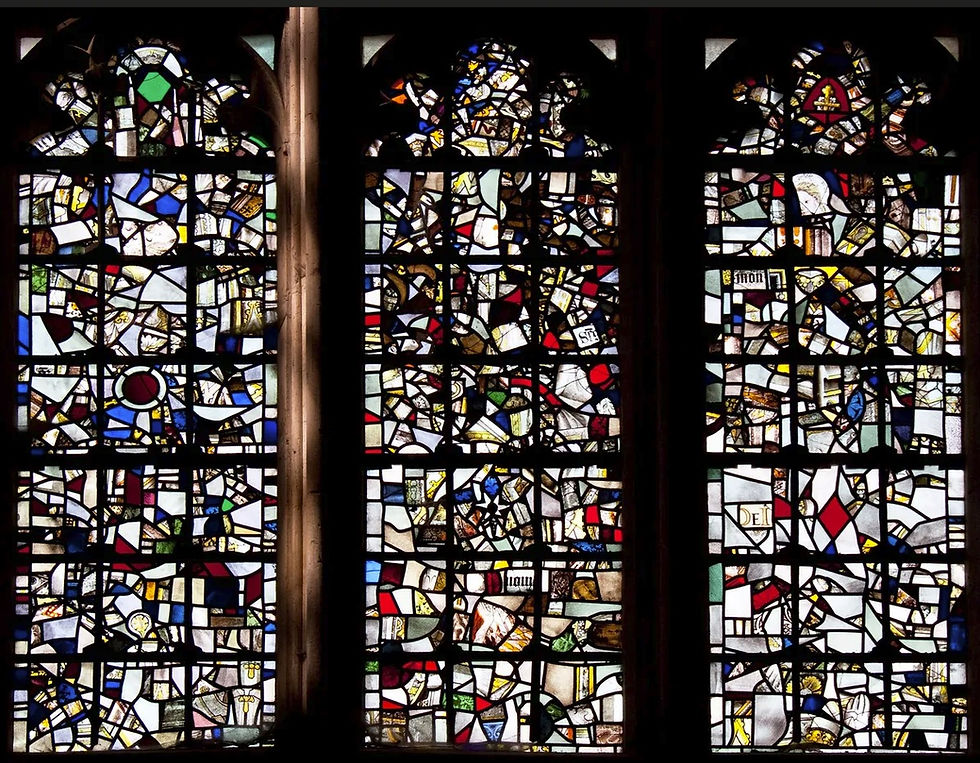
High up in Winchester Cathedral in England, sits a beautiful stained-glass window unique to its era. It neither tells a sacred story nor memorializes a saint, and its kaleidoscope of colors has a peculiarly modern design. Known as the Great West Window, the window is a relic from a difficult time, when in the mid-1600s Oliver Cromwell’s Puritan army used iron bars to shatter the cathedral’s ancient windows, leaving the ground outside littered with glass fragments, which the people of the town picked up and stored until that tragic time passed.
Years later, a cathedral worker volunteered to reinstall the window. High above the nave he assembled those shattered pieces into an abstraction of color. Today the reconstructed bits of glass form an artistic work of great beauty. The play of light from the sun and clouds filters through the window to illuminate the cathedral in a constantly changing mosaic.
This remarkable window reminds us that the Divine Artist is like a loving, gentle, and patient art restorer, who longs for nothing more than to see us reflect the original beauty and life intended for us. As an overflowing artesian well, experiencing this deeply within, can be the most beautiful, transformational and restorative thing imaginable.
__________________________________
For more information on “Operation Night Watch,” see:
-Video on the restoration: https://www.youtube.com/watch?v=yIhRrK74nUQ
-Rijksmuseum website page on "Operation Night Watch": https://www.rijksmuseum.nl/en/stories/operation-night-watch