Baba’s Art School – 101: #23 - "Removing the Masks on Life's Journey"
- Paul G. Chandler

- Aug 15, 2025
- 5 min read
“You can’t begin too soon to encourage an appreciation of art! And each artwork has a story.”
REMOVING THE MASKS ON LIFE'S JOURNEY - by Paul G. Chandler

My grandkids love dressing up, whether as Disney characters or superheroes. Often it involves a mask or disguise of some kind. Once their faces are covered, they feel they can take on a new identities and assume different attributes and powers.
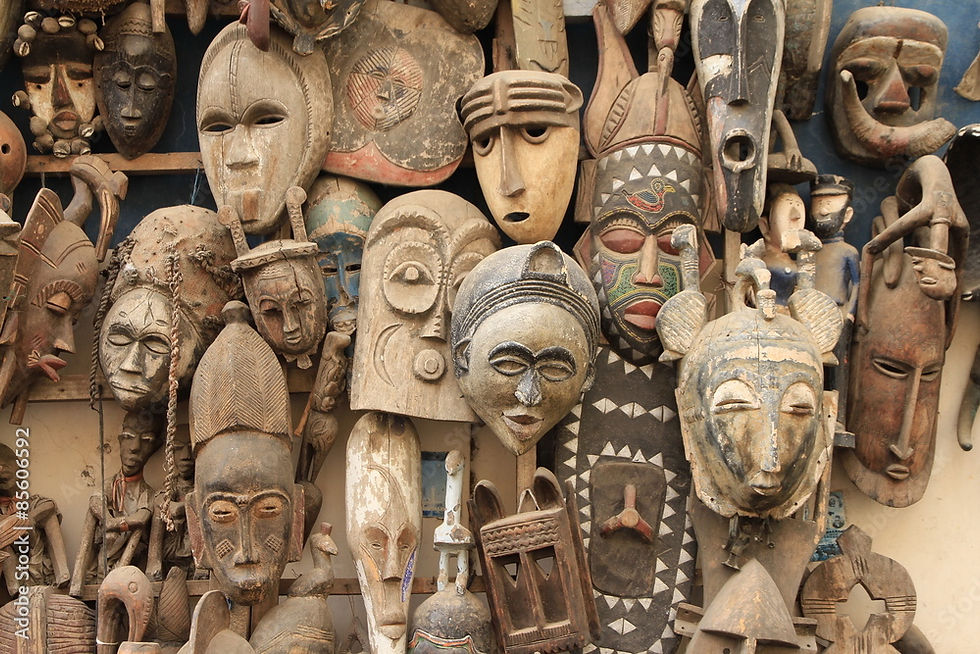
With their love of masks, I decided to show them some African masks that I have in my collection. Masks are iconic symbols of African traditional art that have played an essential role in their culture for thousands of years. The masks are hand-carved by skilled artisans, and each mask has a distinct meaning and symbolism that is closely tied to the cultural and social context in which it was created. It is creative work that not only employs specific techniques but also requires a certain spiritual and cultural knowledge. Hence, these masks are often imbued with intense symbolic significance.
There are numerous African tribes to whom masks play a significant role in the defining of their culture. One such prominent people are the Senufo, a tribe in northern Cote d’Ivoire, West Africa, not far from where I went to boarding school.
The first mask I showed my grandkids was a Senufo mask. Often Senufo masks are referred to as “double masks,” due to the appearance of having two layers. The Senufo people wear their masks in ceremonies and rituals such as harvest celebrations, funerals, rites of passage, weddings and investitures. They are also used in performances and storytelling, and convey specific messages, emotions, or characters

The second mask I introduced my grandkids to originated in Senegal, where I grew up. It is from the historic city of Saint-Louis there, and is known as a “fisherman mask,” as fishermen use them in their celebratory dances.


It is quite fascinating how African masks have significantly influenced modern and contemporary art in the West. For example, early 20th-century artists Henri Matisse and Pablo Picasso were inspired by the abstract shapes and symbolism found in African masks. Drawn to the power of their simplicity, the facial feature exaggerations of African masks provided them a fresh perspective, away from the conventional Western perspective of art.
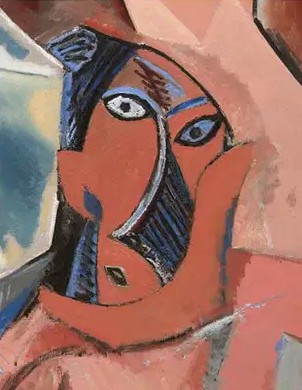
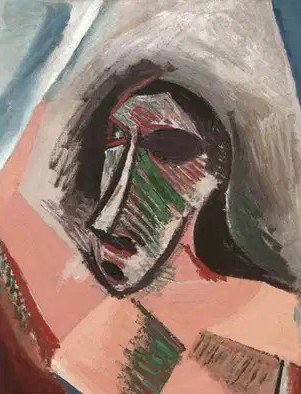
Upon being introduced to African art, Matisse wrote, "I was confronted with an art that spoke directly to my soul. It was like a thunderbolt.” In 1907, Matisse introduced traditional African art to Picasso, who developed a fascination with African masks that would last throughout his career. They were unlike anything he had encountered before. Picasso went on to incorporate elements of African masks into his groundbreaking paintings, such as Les Demoiselles d'Avignon, which depicts five women with angular, mask-like faces. It is now considered one of the most important works of modern art.

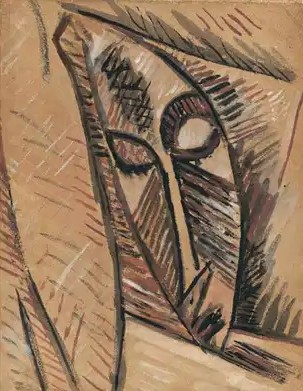


Left: Pablo Picasso, Study for the Head of Nude with Drapery, 1907, Watercolor and gouache on Brown paper, 31 x 24.5 cm (Museo Nacional Thyssen-Bornemisza, Madrid)
Middle & Right: Pablo Picasso, Details of women’s faces in Les Demoiselles d’Avignon,1907 (via MoMA, New York)
Picasso saw in African masks a spirituality that deeply moved him. Upon visiting an exhibition of traditional African art in Paris, he wrote: “. . .I forced myself to stay, to examine these masks, all those objects that people had created with a sacred and magical purpose, to serve as intermediaries between them and the unknown. . . then I understood what painting really meant. It is not an aesthetic process; it is a form of magic. . . The day I understood that, I found my way.”
There is something transcendent in the very nature of African masks, as they have a much deeper meaning than their surface appearances. Traditionally, they are often used to facilitate connections between the human world and the spiritual dimension of life during ceremonies.
I find these masks can also remind us of something profoundly important for our spiritual journeys. Masks are just that – masks. They conceal one’s truest appearance. Reflecting on masks, the Nigerian writer and Nobel Prize for Literature laurate Wole Soyinka wrote; “The mask is a peculiar device. It may conceal or reveal, but it never tells the truth.”

“The mask is a peculiar device. It may conceal or reveal, but it never tells the truth.”
-Wole Soyinka
We all undoubtedly wear masks of one sort or another in certain contexts or periods within life’s drama; whether for family, friends, adversaries, and even sometimes while alone. And the masks we don say so much about us. As Oscar Wilde rightly observed, “A mask tells us more than a face.”
I have come to believe that one of the most profound objectives of our spiritual journeys is reaching a state of being the most fully “authentic” individual we can possibly be. I am interpreting “authenticity” to mean that all parts of oneself are in sync with every other part, forming an integral whole. This results in someone seeing us for who we really are – with our truest face showing, where no masks exist.
Whether we like it or not, we are surrounded in life by masks of every imaginable sort; masks of our own making and masks on others. In my experience, it is often during personal hardship that we are able to discern who and what is masked. It can sometimes lead to profound disappointment and even a sense of betrayal to discover what may have been a façade. I have learned that even institutions can wear masks. I once worked for a faith-based institution whose public face was all about love, where the concepts of unconditional love, inclusivity, truth, compassion and justice formed its public face. However, through a difficult and unfortunate situation, I experienced that at the highest levels of the institution at that time, its public persona was a mask.
However, the only “unmasking” we have any control over is our own. Therefore, one of the things I wish most for my grandkids as they grow and mature socially and spiritually is to have the wisdom, strength and courage to be fully “authentic,” regardless of the circumstances that life presents them, never feeling they need to “mask up.” For true security, freedom and wholeness are found when “what you see is truly what you get.”
P.S. Both of my older grandkids loved touching these masks, and identifying the unusually shaped noses, mouths and eyes on them with their hands.